
ABT Framework Student Resource Page Round 43 – Emory – MSCR 515
Contents
Sign up to host your Working Circle here (separate page)
Sign up to participate in Working Circles here (separate page)
Session 2 Resources – Singular Narrative
Session 3 Resources – Dream and Abstract Analysis
Session 4 Resources – Archplot vs Miniplot
Session 5 Resources – Narrative Metrics
Session 6 Resources – Working Circle Practice and Abstract Analysis #2
Session 7 Resources – Hero’s Journey, Business, and Proposals with Park Howell & Dianna Padilla
Session 8 Resources – Narrative Spiral with Nancy Knowlton
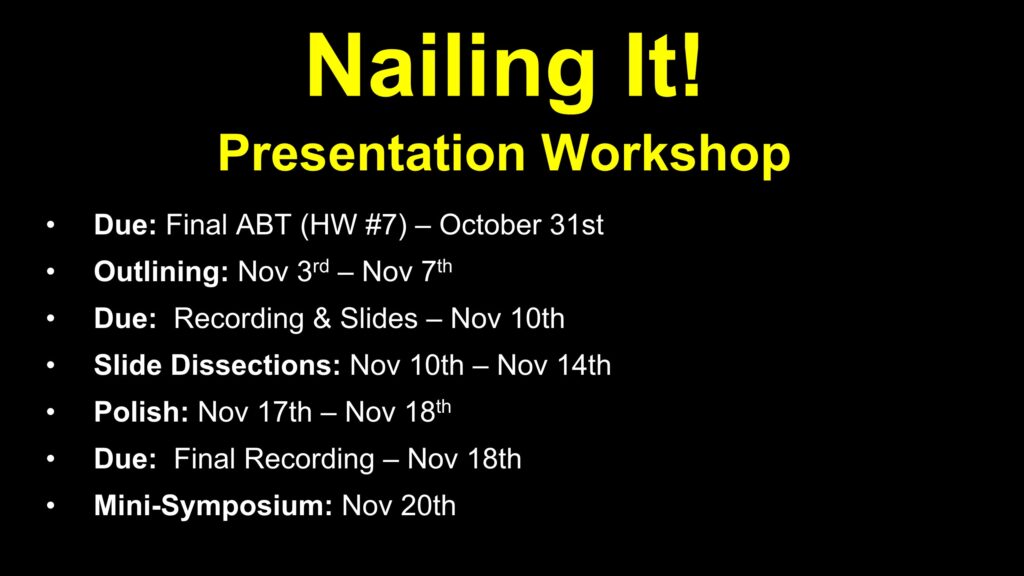
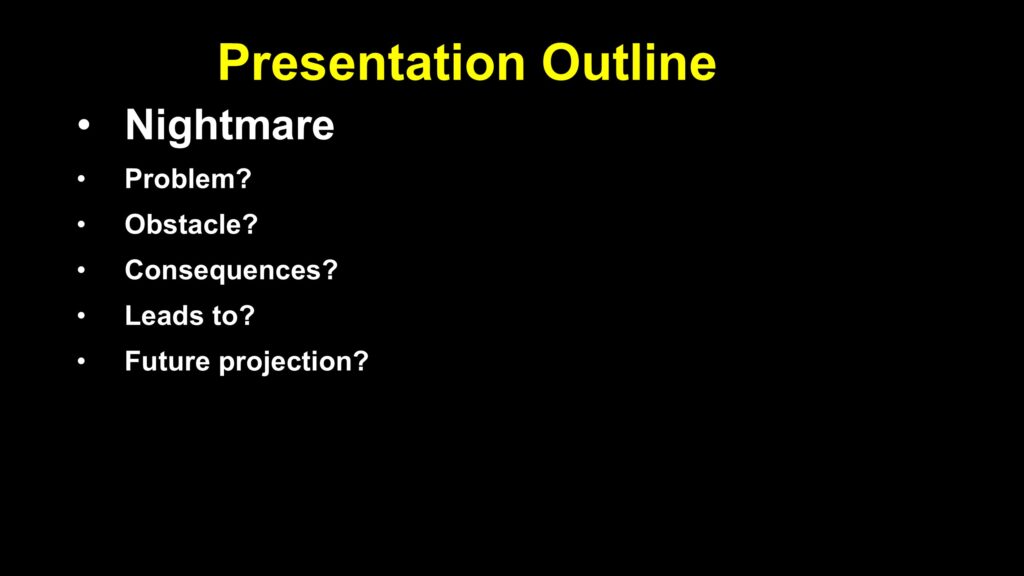
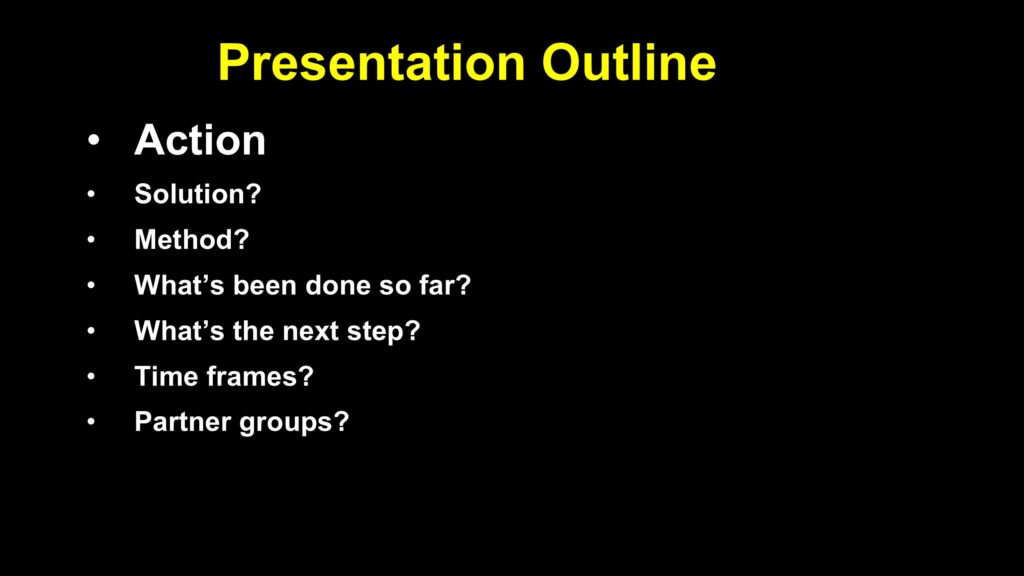
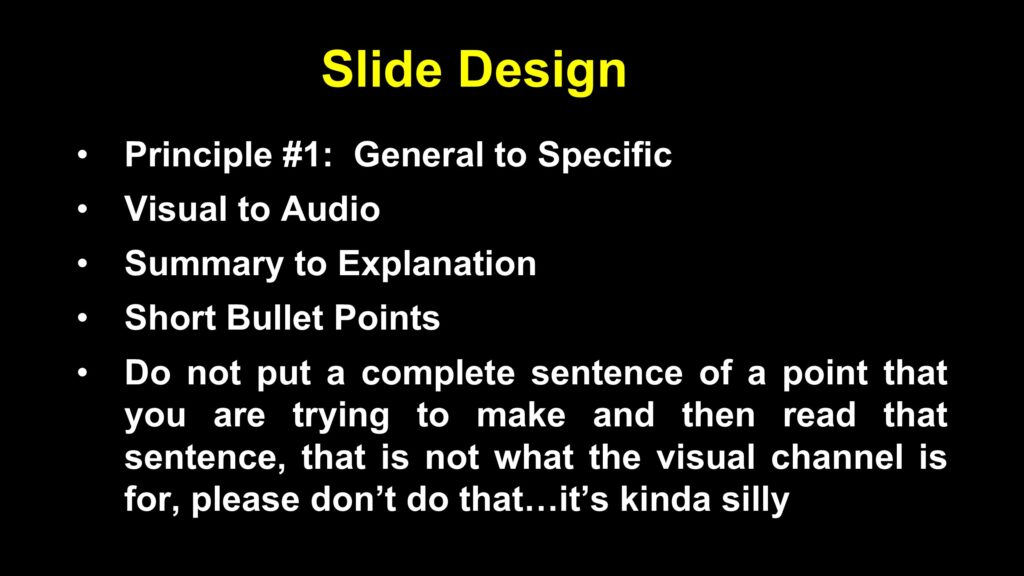
Session 9 Resources – Presentation Preparation
If you’re new to Working Circles, start by watching this:
Working Circle Half Hour Schedule – Use this to guide you through how to host your half hour Working Circle.
The Scribe Document – Your designated Scribe should have a copy of this shared on the screen and use for note taking.
To complete the class, you must sign up to host 1 Working Circle and sign up to participate in 2 Working Circles.
Sign up to host a Working Circle
- Pick an available half hour time slot on this page.
- Fill in your first name, last name, and a short title for your Working Circle based on your ABT.
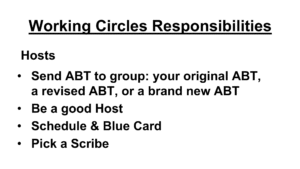
Host responsibilities
- Email your participants your ABT before the Working Circle so they have time to review it – we’ll send you the list of your participants’ email addresses 3-5 days ahead of time.
- You can send your participants a revised ABT of what you originally submitted to class or use a brand new ABT all together.
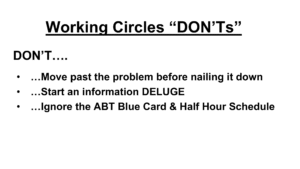
- During the Working Circle, use the ABT Blue Card and follow the half hour schedule.
- You’re the moderator of the discussion, so do your best to make sure everyone gets a chance to speak and provide input.
- We’ll send you and your participants a Zoom link for your Working Circle 3-5 days before you’re scheduled to host, so no need to worry about that.
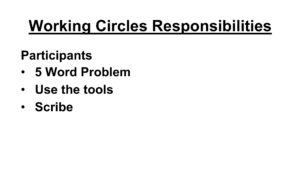
Participant responsibilities
- Sign up to participate in a minimum of 2 Working Circles. Sign up here.
- Review the ABT that the host sent you ahead of time and come up with your version of the 5 Word Problem (this will be discussed in class) for the host’s ABT before the Working Circle starts.
- One participant should volunteer to be the notetaking Scribe. The Scribe will share their screen so that everyone can view it and have a Word document up to take notes. You can find a premade Scribe document in Word here.
- (Optional) Participants can rewrite the host’s ABT and present the rewritten ABT to the host during the Working Circle. This approach is for participants who want a little extra practice and to give the host more options and ideas for rewriting their ABT. So far we’ve had reports back that hosts are incredibly grateful when participants do this.
- Be prepared to use the ABT Blue Card and all the tools you’ve learned in class to help the host clarify their narrative.
Zoom Sessions:
- Thursdays @ 2:00 pm Eastern Time
- Start Date: 8/28
- End Date: 11/20
In person session:
- Thursday, October 25th @ 2:00 pm Eastern
- Location: TBD.
Download the syllabus here: MSCR 515 – fall 2025 v2.
Sign up to host a Working Circle (see above)
Download the ABT Blue Card – Have it open or printed out and ready for each class.
Email your first ABT to mattmdavid@gmail.com
Checklist for writing your first ABT
- Your ABT should be an active problem that you are working on – please use a work or research project for this, such as grant proposals, research papers, team projects, job talks, etc.
- Please make sure your ABT is only one sentence (it can be lengthy).
- It must use the three words: AND, BUT, THEREFORE.
- The AND section should be used to provide the basic setup needed to understand the context of your narrative.
- The BUT section should be a statement of the problem.
- The THEREFORE section should be your solution to the problem.
- First drafts are preferred! Don’t spend more than 10 minutes writing your ABT.
- Also, don’t sweat it too much on writing this first ABT! The whole purpose of the workshop is to improve on what you’ve got. There will be no destructive criticism — it’s all about using the ABT Framework to strengthen the narrative core of what you want to communicate.



The South Park creators talking about the ABT’s “Rule of Replacement.”
Don’t Be Such a Scientist, Second Edition: Talking Substance in an Age of Style: If you want a deep diagnosis of the problems with science communication, this is the book to start with.
Houston, We Have a Narrative: Why Science Needs Story: This book is for those looking for a deeper dive into the academic theory behind narrative and the ABT.
Working Circles Participant Sign Up Sheet: Sign up to participate in other Working Circles.
Optional Exercise #1: The 5 Word Problem
“What’s the problem?” is the one of the most common questions Randy and Matthew ask during the ABT Builds. For this exercise, look at your ABT and try to finish this sentence “The problem is _____” and use only 5 additional words. Come up with one version of “The problem is ____” for the Ultimate Problem and one version for the Proximate Problem.
Stripping down your problem to just 5 words can help you clarify what your narrative is actually all about and focus in on the real problem that you want to address.
Session 2 Resources – Singular Narrative
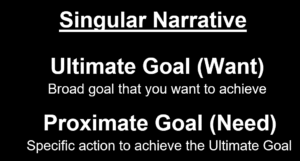
The One Thing:
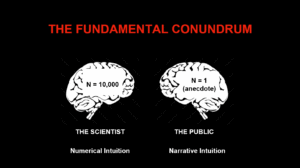

Nicholas Kristof’s Advice for Saving the World – The importance of the singular narrative. Once you increase the size of a narrative from one person in need to two people in need, compassion drops in the audience.
Compassion Fade: Affect and Charity Are Greatest for a Single Child in Need – The research article that “Advice for Saving the World” references.
‘Data-Driven’ Campaigns Are Killing the Democratic Party – The article in which Dave Gold coined the term “Christmas Tree” when looking for an overarching problem. It’s okay to have several problems in your narrative, but you need to find the overarching Christmas Tree problem for your narrative that all the other problems can hang off of like ornaments.
Off With the Talking Heads: A Plea for One COVID Voice – Randy’s Medpage article where he talks about the importance of the singular narrative.
Three Forms of the ABT – It’s recommended you read this excerpt from Houston, We Have a Narrative and get an understanding of the cABT (Conversational ABT).
Optional Exercise #2 – “This is a story of…” – Change
This is an exercise that would be handy to have done before your in class ABT Build with Matthew or Randy because they ask this question for roughly 99% of ABT Builds.
For this exercise, tell us what your ABT is about by finishing this sentence and using only 3 additional words “This is a story of____.”
It seems simple, but this exercise is tricky because participants tend to focus on the subject. But stories need more than a subject, they need change. Look at your ABT and see what major change you want to occur. Your story starts at point A and ends at point B – what’s the change that you want to get us to point B?
Examples of changes in past ABTs:
- Protecting a species
- Strategizing building restoration
- Managing conservation efforts
- Restoring wildlife
- Adapting to change
- Educating our stakeholders
- Understanding a disease
- Developing better methods
Look at this example ABT:
Congressional funding is a key requirement for the continuation of important avian research, and we know that our research allows us to be better able to manage our wildlife habitats and protect endangered species. But program managers don’t feel confident about securing future funding because some research areas are not receiving enough attention. Therefore, we need to effectively promote the proven success in these research areas to secure future funding.
When asked to complete the sentence “This is a story of____,” a possibility is “This is a story of avian research.” But avian research is just a noun in this case. It doesn’t tell us what change or process is taking place in this story. You need to add what the change or process is that is taking place.
At the Ultimate level, you could say “This is a story of continuing avian research.” Continuing marks the process and is what makes this a story.
At the Proximate level, you could say “this is a story of securing future funding.” By fulfilling the Proximate goal (securing future funding) you are one step closer to the Ultimate goal (continuing avian research).
Try to fill in “This is a story of____” for your ABT using only 3 additional words (focusing on the change or process) or less. Do one version for the Ultimate and one for the Proximate.
Session 3 Resources – Dream and Abstract Analysis
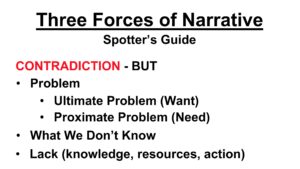

Optional Exercise #3: Using the Dobzhansky Template to find your “One Thing.”
Knowing the “theme” (i.e., central argument) for your narrative is an important guide for making sure your narrative stays on message and the Dobzhansky Template is the tool that we use to find your theme. Restructure your ABT in the form of a Dobzhansky Template.
Dobzhansky Template: Nothing in _______ makes sense, except in the light of ________.
Examples: Nothing in biology makes sense, except in the light of evolution.
Nothing in geology makes sense, except in the light of plate tectonics.
Nothing in the management of mule deer makes sense except in the light of correctly estimating abundance.
Nothing in the challenge of teaching human anatomy makes sense except in the light of time management.
Session 4 Resources – Archplot Vs Miniplot
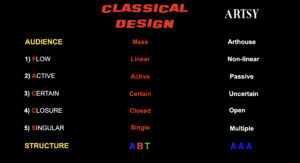
Optional Exercise #4: cABT – Starting from simplicity
Randy or Matthew might ask you the cABT version of your ABT, so for this exercise you’ll prepare your cABT ahead of time.
The cABT should have all specifics stripped off of it. Use nothing but generic words, like “thing” and “stuff.” For example, if your ABT dealt with a new way to clean junk from the ocean that’s an improvement and the old system is outdated, the cABT would be “We had a thing we were using for a while, but it’s not working that great, so now we want to use a better thing.”
See? We can’t tell that you’re working on cleaning the environment. You could just as well be telling me that you’re implementing a new accounting system at your bank for all we know. That makes it a good cABT.
This exercise is important in making sure you have an easily understood base narrative, that you really know what the narrative core of your ABT is all about. And then from the base cABT, you can start adding specifics again when constructing your kABT.
Session 5 Resources – Narrative Metrics
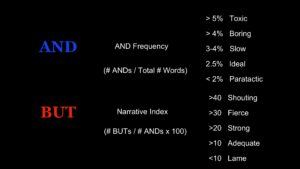
The Two Narrative Metrics – Randy’s Substack post that explains the two narrative metrics: the AF (And Frequency) and the NI (Narrative Index).
The ABT-ometer – Our tool to quickly calculate narrative metrics by copying in your text.
Bankspeak: The Language of World Bank Reports, 1946–2012 – The Literary Lab report on how the World Bank reports are completely unreadable, due in no small part to the overuse of the word “and” to glue together contradicting statements.
A spat over language erupts at the World Bank – The somewhat dismissive Economist article on the “conjunction dysfunction” about the Literary Lab’s report.
The Longman Grammar of Spoken and Written English is a 7 year foundational study that took a quantitative analysis approach to the English language. It found that the ideal percentage of Ands in well edited documents tend to converge around 2.5%.
Optional Exercise #5: Ordinary World – Framing your ABT
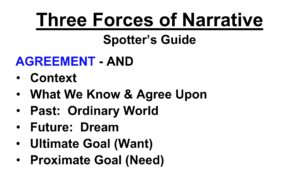
Setting up the Ordinary World is important for correctly framing your ABT so that you audience understands your topic at a broad level. If you can set it up correctly, then it makes it easier to quickly dive into the stakes and get buy-in from your audience ASAP.
But we’ve found getting the right Ordinary World is extremely tricky because framing your topic at the right level takes practice.
So get some practice, in this exercise, I want you to make three attempts at the Ordinary World for your ABT. Come up with three different possibilities for the wording of the broad topic and use each to complete this sentence to create three different versions:
(Broad Topic) is important for/because ______________.
After you come up with three versions, pick the one that you like best.
Need an example of the Ordinary World? Go back and read the first sentence of this optional exercise! 🙂
Session 6 Resources – Working Circle Practice & Abstract Analysis #2
ABT Longform color coding
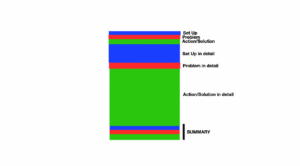
Optional Exercise #6: Hypothesis Testing with Metrics
Let’s play a game of Expected vs Observed.
First, take a look at this chart to refresh yourself on the ranges for the metrics:
Next, pick an article from a mainstream news site of your choice (New York Times, CNN, etc.). What kind of scores would you expect from a mainstream article? Find out how accurate you are. Copy the body of the article into our ABT-ometer and click Analyze. Were you close? Try one or two more from mainstream sources and see if the results are similar.
Next, pick an article from a less mainstream science or medical publication (MedPage Today, Advanced Science News, etc.) What kind of scores would you expect on sites like these? Find out how accurate you are. Copy the body of the article into our ABT-ometer and click Analyze. Were you close? Try one or two more from less mainstream sources and see if the results are similar.
Session 7 Resources – Hero’s Journey, Business, & Proposals w/ Park Howell & Dianna Padilla
Matthew Winkler Video: What makes a hero? – We only watched the first two minutes in class. Watch this to the end to see how the hero’s journey applies to your life:
Defining “Story” versus “Narrative” – Randy’s blog post on the difference between “story” versus “narrative” in which he further defines the Monomyth.
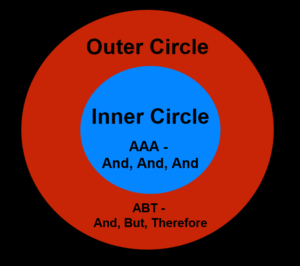
Are You Confused by Scientific Jargon? So Are Scientists – A New York Times article recommended by Dianna about how jargon clogs up scientific papers to the point that other scientists can’t understand them. Remember: your Inner Circle is always smaller than you think it is.
Chaos in the brickyard – A famous Science Magazine letter on scientists, their obsessions, and squandered effort.
Park Howell’s Business of Storytelling Podcast
Learn From My 10-Year Journey With The ABTs of Storytelling – Park Howell’s 400th episode of his Business of Story podcast in which he highlights his favorite moments with the ABT from previous episodes.
Brand Bewitchery: How to Wield the Story Cycle System to Craft Spellbinding Stories for Your Brand – Park Howell’s book on using the ABT and the Hero’s Journey to help market your brand.
The Narrative Gym for Business: Introducing the ABT Framework for Business Communication and Messaging – The business version of the Narrative Gym, written by Park and Randy.
Session 8 Resources – Narrative Spiral w/ Nancy Knowlton
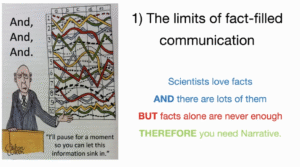
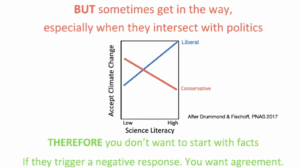
Individuals with greater science literacy and education have more polarized beliefs on controversial science topics – The paper Nancy referenced that shows how science literacy and political affiliation affect belief in controversial topics. Despite what scientists would like to believe, more information isn’t always the right answer.
Citizens of the Sea: Wondrous Creatures From the Census of Marine Life – Nancy Knowlton’s book.
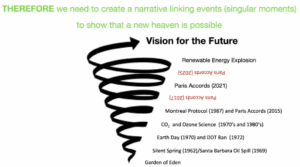
Earth Optimism – A movement that Nancy is heavily involved in to help highlight the upward rise of the climate movement’s narrative spiral.
Katharine Hayhoe – The Evangelical Christian and Climate Scientist who emphasizes shared values when teaching about climate change.
Session 9 Resources – Presentation Preparation



ABT Agenda– Randy Olson’s Substack.
@ABTAgenda – Follow Randy on Twitter.
ABT Time Podcast – All things ABT, start to finish. In this weekly hour long post Randy will discuss observations, applications and implications of this powerful tool that is at the core of his narrative training program and effective communication of all forms.
The ABT Agenda Newsletter – We send out a newsletter a few times a year with new ABT related events, news, and course updates. If you sign up, we promise not to spam you with tons of junk!
Communication Books by Randy Olson
They Say, I Say by Gerald Graff and Cathy Birkenstein – A book for an ABT like approach to argumentation.
Step by Step to Stand-up Comedy by Greg Dean – A book that takes a structured approach to joke writing with a focus on the AND and the BUT (i.e., Setup and Punchline).
The Writer’s Journey by Christopher Vogler – If you ever wanted an in depth look at storytelling, THIS is the book. Draws heavily from Joseph Campbell’s Hero’s Journey and is based on Vogler’s 7 page memo that reshaped Hollywood.